
Shagbark Hickory Hulls: A Little Bit of Magic

Updated: Oct 29, 2025

Dyeing with Shagbark Hickory hulls has a fascinating trick! The general question is: do you want to work with the dark, almost composting hulls, or are you after the freshly fallen ones? And should you use them with or without the nut inside?
All hulls contain tannins, so theoretically, they don't need a mordant. However, adding one can drastically change the resulting colors. With Black Walnut hulls, for example, the darker the better! I actually let mine rot in a bucket of water for a few days to release as much tannic acid as possible. For this type I don’t bother with removing the nuts.
But with Shagbark Hickory hulls, I'm aiming for less tannin because there are other colors besides brown to be found. Hint: Pink!
Below - Pink on Linen
The Predictable Brown (And Why We Go Beyond It)
If you use the dark brown Shagbark Hickory hulls, (nuts removed) you get the predictable results: browns, golden browns, and dark tans. You can see that in my initial samples below:
Top Row - Alum: In this sample, I used brown hulls, hot water, and potassium aluminum sulfate.

Bottom Row - Copper: In this sample, I used brown hulls, hot water, and copper sulfate.
This year, I wanted to try something different. I started back in 2024 with a quick test, putting hulls into mason jars with various mordants to see what color options there were. This year, I focused only on the fresh hulls—the ones without any brown discoloration. They are a very pretty yellow with lovely hints of pink!
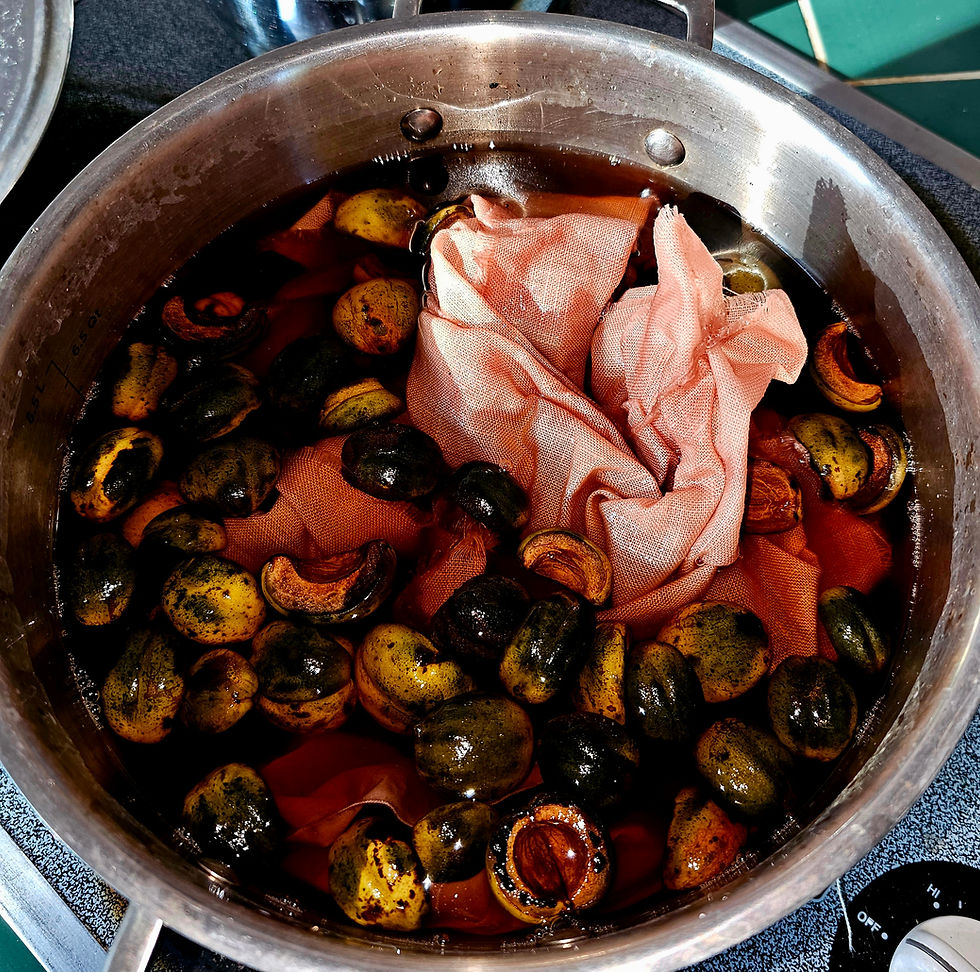
After removing the nuts, I let the hulls sit in the pot with room temperature municipal water (pH 7), added aluminum triformate, and placed my fabric samples in. Over the next few days, the water turned a beautiful pink.
Here's the magic trick: not every fabric came out pink! To be clear, these four samples were in the exact same pot, at the same temperature, for the same duration of time.
Below - Wool, Silk, Linen, Cotton

Why the Difference? The Science Behind the Surprise
Not only do different types of mordants shift your color, but even similar mordants (like different types of aluminum) can yield dramatically different results, especially with something like aluminum triformate.
In this case, the cellulose fibers (cotton, linen) absorbed the beautiful pink tint, while the protein fibers (silk, wool) took on more of the tannic acids, resulting in a golden (silk) and brown (wool) color.
So, what is happening here?
1. Temperature Matters: A hot water bath releases much more of the tannic acid from the hulls, resulting in a golden or brown dyebath. The tannins completely overwhelm any other colors present. By working with room temperature water, less tannic acid is released, allowing the gorgeous pink to finally shine through!
2. The Mordant is a Factor: The choice of mordant, aluminum triformate, is clearly affecting the colors differently than potassium aluminum sulfate or aluminum sulfate would have.
3. Multiple Compounds at Play (My Theory!): The most exciting possibility is that every dye source contains a multitude of chemical compounds. Some, like tannins, can overwhelm other colors, as I mentioned before. However, there are other families of compounds, including anthraquinones (reds), flavonoids (yellows), and indigotin (blues).
For example, safflower contains both yellows and pinks, but you have to wash out the yellows to reach the pinks. In this case, I theorize that different dye compounds are attaching to different fabrics. The cellulose fibers (cotton, linen) don't take up tannins as easily as protein fibers, but they seem to bond perfectly with this anthraquinone compound, producing the pinks. On the protein fibers (silk, wool), the tannins are overwhelming the pinks to varying degrees.
Either way—it's magic!
I might have actually cackled when I pulled out the fabric samples with such radically different colors from the very same dye pot.

